
Good Morning Friends,
Today is the Fourth of July, and many began the celebration in advance and will have it as a day off tomorrow. It seems rare for it to fall on a Sunday. For me, it has prompted me to consider all the hats I have worn in our past, currently wear now and might well wear in the future. And as I contemplate this, with some degree of honest introspection, it becomes evident that I need to be healed of my sins to really be free to become the person God intended. However, one question stares me in the face and challenges me and perhaps you too, to answer truthfully related to our own wounds and healing. It is about how we welcome Christ into the celebration of our lives together. And I wonder, Are Doubts Getting In The Way Of Us Having Our Primary Identity In Christ?
Scripture: So then you are no longer strangers and aliens, but you are citizens with the saints and also members of the household of God, built upon the foundation of the apostles and prophets, with Christ Jesus himself as the cornerstone. In him the whole structure is joined together and grows into a holy temple in the Lord; in whom you also are built together spiritually into a dwelling place for God.
Ephesians 2:19-22 (NRSV)
But Thomas (who was called the Twin), one of the twelve, was not with them when Jesus came. So the other disciples told him, “We have seen the Lord.” But he said to them, “Unless I see the mark of the nails in his hands, and put my finger in the mark of the nails and my hand in his side, I will not believe.” A week later his disciples were again in the house, and Thomas was with them. Although the doors were shut, Jesus came and stood among them and said, “Peace be with you.” Then he said to Thomas, “Put your finger here and see my hands. Reach out your hand and put it in my side. Do not doubt but believe.” Thomas answered him, “My Lord and my God!” Jesus said to him, “Have you believed because you have seen me? Blessed are those who have not seen and yet have come to believe.”
John 20:24-29 (NRSV)
And when he spoke to me, a spirit entered into me and set me on my feet; and I heard him speaking to me. He said to me, Mortal, I am sending you to the people of Israel, to a nation of rebels who have rebelled against me; they and their ancestors have transgressed against me to this very day. The descendants are impudent and stubborn. I am sending you to them, and you shall say to them, “Thus says the Lord God.” Whether they hear or refuse to hear (for they are a rebellious house), they shall know that there has been a prophet among them.
Ezekiel 2:2-5 (NRSV)
even considering the exceptional character of the revelations. Therefore, to keep me from being too elated, a thorn was given me in the flesh, a messenger of Satan to torment me, to keep me from being too elated. Three times I appealed to the Lord about this, that it would leave me, but he said to me, “My grace is sufficient for you, for power is made perfect in weakness.” So, I will boast all the more gladly of my weaknesses, so that the power of Christ may dwell in me. Therefore I am content with weaknesses, insults, hardships, persecutions, and calamities for the sake of Christ; for whenever I am weak, then I am strong.
2 Corinthians 12:7-10 (NRSV)
He left that place and came to his hometown, and his disciples followed him. On the sabbath he began to teach in the synagogue, and many who heard him were astounded. They said, “Where did this man get all this? What is this wisdom that has been given to him? What deeds of power are being done by his hands! Is not this the carpenter, the son of Mary and brother of James and Joses and Judas and Simon, and are not his sisters here with us?” And they took offense at him. Then Jesus said to them, “Prophets are not without honor, except in their hometown, and among their own kin, and in their own house.” And he could do no deed of power there, except that he laid his hands on a few sick people and cured them. And he was amazed at their unbelief. Then he went about among the villages teaching.
Mark 6:1-6a (NRSV)
Message: If we are not seeking to find our identity in Christ first, then we are seeking it in something else to our own detriment. For even though we believe our identity is in Christ we typically do not make it a priority and as a result fail to experience how this relationship is to change the way we live in practical ways. We typically discount this identity and get it all mixed up with being a spouse, parent, employee, and member of one group or another. As the Apostle Paul came to the end of writing the second letter to the Ephesians, he explains that the Christians in the church in Ephesus had a new identity. They had transferred their allegiance from their former way of life, and they now had a new identity in Christ. Paul writes about their citizenship alluding to citizenship of God’s kingdom. Here the Kingdom of God is not a territorial jurisdiction, it is God himself ruling his people, and bestowing upon them all the privileges and responsibilities which divine rule implies. To this new international God-ruled community, Gentiles and Jews, slave and free, male and female, belonged on equal terms. Interestingly, Paul is writing while the Roman Empire has yet to show signs of its coming decline, let alone of its fall. Yet Paul sees this other kingdom of God as more splendid and enduring than Rome’s. And so, Paul rejoices in its citizenship more even than in his Roman citizenship. It is a kingdom made possible by the resurrected body of Christ. The walls and locked doors and boarders are no barrier to the resurrected Christ. Here Jesus ushers in this new kingdom proclaiming a relationship of peace but also displaying the marks of suffering on the Cross, all as witness that though the Lord has been crucified, he has most surely risen from the dead so we too might be changed. So, friends, this morning be confident that having one’s primary identity in Christ will produce things of eternal value. The
great purpose in our lives is to identify with and become more like Christ.
And So, today we have been exploring how power can be made perfect in weakness and how God helps us to overcome our rebellious nature in submitting to God. Here positive outcomes seem to hinge on attitude and grace and the work of the Holy Spirit too. As Jesus returned to His hometown of Nazareth for the second time, His reception was not any better than the first visit. He was not welcomed because they did not identify with Jesus.
He was not accepted and appreciated among His own people in part because of their identification with political powers that clouded their experience. We too can be strangers in a strange land, or we can be more. You see, we are a people of hurt every one of us…. physical pain, emotional pain, addictions, cancers, insecurities, and angers plague all those in the pews and those who have never seen one. Sadly, it is in our weaknesses as much as our strengths how we identify who we are. The question though is whether or not we want to own our hurt forever. And we probably will if we do not overcome our doubt enough to believe in a love greater than ourselves. Yes, part of the question is whether we want to get well. Perhaps you are working for God. Then again perhaps you are working for man. You really have to choose what you are going to do. One really has to think this through…. our actions…our motives. Take Thomas…. doubting Thomas. Why was he so concerned with the wounds? Oh, I understand his doubting. Without doubting there is no faith. What I do not get is Thomas’ logic. This is one confused man…incredulous and in denial. Did he really believe there was not a gaping hole in this man’s side? Really, why where the holes in the hands and side a satisfaction for the burden of proof for the real issue at hand? Thomas was not at the crucifixion and was not at the Resurrection. Ok I get that. But if Thomas wanted some proof this was Jesus…a risen Christ…, why does he contemplate poking a finger in Jesus to solve the issue? Why did Thomas not ask Jesus a personal question like: “Jesus, what did you say to me last week when you washed my feet?” If I were really doubting, I would have asked something like that, but it seems that the wounds were more of interest to Thomas than a means of identification. What is going on here? Friends, the only thing that makes sense to me is that Thomas was identifying his own wounds with Christ’s wounds more than worldly logic would lay claim to. Maybe we too will know each other by our wounds. Maybe Thomas needed the healing of his wounds. Maybe in a strange way Thomas was asking Christ to poke into his wounds too and to heal him. Maybe that was what Thomas was really looking for all along…. healing. Here healing, whether it is of a nation or an individual, happens when we too realize we might be healed by Jesus’ wounds. Here healing happens when we realize we too might be an agent of healing and demonstrate we have faith enough to place our identity in Christ. None of us can do that alone. We need Jesus. That is why we must welcome Jesus, wounds, and all. For further meditation on this I have included a copy of Caravaggio’s Doubting Thomas for your consideration. Note that Jesus looks much younger than the disciples in the painting.
Pray we realize that we too are weak, but that God is strong. Pray we are not too proud or haughty of self-absorbed. Pray we are not hypocrites but humble. Pray we are familiar with Jesus and face our weaknesses with Him. Pray we are satisfied with what we have but still strive for justice and love in the power of the Holy Spirit for an abundant life. Pray we be healed, but if we are not, discover the hidden blessings in weakness. Pray we realize that God’s love and care for us does not depend upon our attitudes, actions, or affections but that when we welcome God’s love our attitudes, actions, and affections we are transformed with Holy Spirit power. Pray we face the truth of ourselves and the wounds we cling to. Pray we do not so identify with our wounds that we reject getting healed. Pray we have a personal encounter with the Risen Christ. Pray we turn and see God’s Kingdom. Pray we experience the joy, love, and peace of the Risen Christ. Pray we have a legacy that is built to last because it is not built on pride. Pray we have an identity as citizens of God’s Kingdom in a place we can call home. Pray we have an identity as members of God’s family, sharing the same Father. Pray we realize that we have no need to judge or compare ourselves to others, but to serve Christ, in whom our identity is hidden as part of a greater whole now being healed.
Blessings,
John Lawson
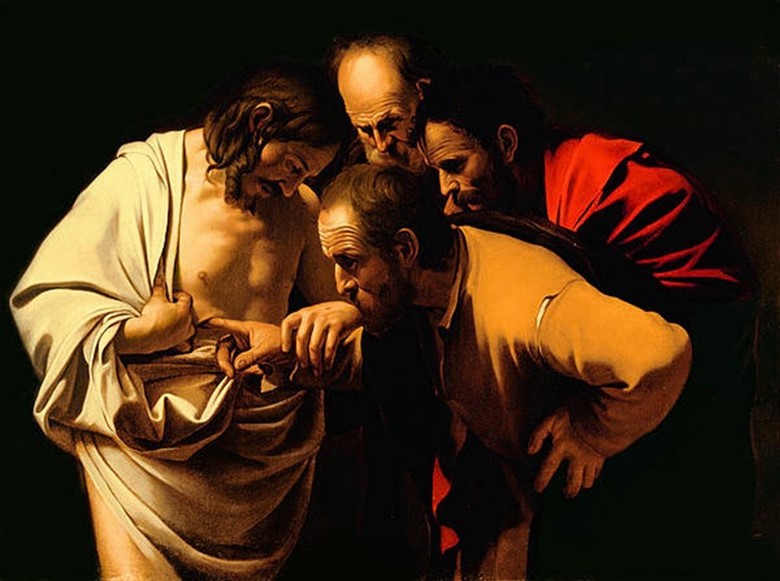
Caravaggio’s Doubting Thomas


Another interesting post Brother John… might I offer two quick comments?
This week I had the opportunity to discuss an old conversation I once had about nouns and adjectives. The question at hand was which was more faithful… to identify as a Christian American or an American Christian. I try to be the latter as the adjective should only offer clarification for the noun. It is not meant to subvert it. Unfortunately, too many folks fall into the first category. For example, the Church where I worship has an American flag in the Sanctuary, but not a Christian flag. Though the question has been raised about why one and not the other, no changes have taken place. I also served a Church once that had both flags, but the American flag had the place of honor. It took the Elders a while to understand my interest in reversing their positions.
Secondly, I think you are overthinking the Thomas question. By the end of that first week the Jewish authorities had spread the rumor all over Jerusalem and the surrounding area that the disciples had come and stolen the body of Jesus and were falsely claiming he had risen from the dead. I have no doubt that Thomas had heard these stories and perhaps gave them a little more credibility than you and I might. After all, he knew how impetuous Peter could be, and James and John were quite willing to do anything to have power. So… he wanted proof. Given the social media twists of the truth we see today, who can blame him?
hesed ve shalom,
LikeLike