Good Morning Friends,
In ancient Greek mythology, the pomegranate was known as the “fruit of the dead” and believed to have sprung from the blood of Adonis. The myth of Persephone, the goddess of the underworld, prominently features her consumption of pomegranate seeds, requiring her to spend a certain number of months in the underworld every year. The significance of pomegranates in the Bible is however not myth. In fact, pomegranates are one of the most prominent fruits mentioned in the Bible. These large red berries, about the size of an orange or a grapefruit, have a thick outer husk filled with two hundred to fourteen hundred seeds individually embedded in juice-filled membranes called sarcotestas. The pomegranate is one of the seven species of fruits and grains listed in the Old Testament as a special product of the land of Israel. It is one of the world’s oldest fruits and is still grown in the Middle East and elsewhere today. Even in my backyard in Florida. The Bible also mentions pomegranates when God instructs Moses about the robe for the high priest, Aaron, that he would wear when approaching God’s presence in the Temple. In today’s painting, Madonna of the Pomegranate by Sandro Botticelli, Jesus holds a pomegranate. Perhaps the openness of the fruit depicting all the seeds is of relevance for us today as it relates to our collective need to be more visible as a body of believers, and I think and believe this relates to the idea of communion with the Holy Spirit in the called-out assembly of God. The hope is that we might produce spiritual fruit worthy of giving to God even as we eat the fruit and bread of life given to us by Christ. The painting for our Visio Divina is by Botticelli. Contemplate the symbolism of the Pomegranate even as we ask, How Do We Feel About Eating The Fruit Of Another’s Labor?
Scripture: Meanwhile Saul, still breathing threats and murder against the disciples of the Lord, went to the high priest and asked him for letters to the synagogues at Damascus, so that if he found any who belonged to the Way, men or women, he might bring them bound to Jerusalem. Now as he was going along and approaching Damascus, suddenly a light from heaven flashed around him. He fell to the ground and heard a voice saying to him, “Saul, Saul, why do you persecute me?” He asked, “Who are you, Lord?” The reply came, “I am Jesus, whom you are persecuting. But get up and enter the city, and you will be told what you are to do.” The men who were traveling with him stood speechless because they heard the voice but saw no one. Saul got up from the ground, and though his eyes were open, he could see nothing; so they led him by the hand and brought him into Damascus. For three days he was without sight, and neither ate nor drank. Now there was a disciple in Damascus named Ananias. The Lord said to him in a vision, “Ananias.” He answered, “Here I am, Lord.” The Lord said to him, “Get up and go to the street called Straight, and at the house of Judas look for a man of Tarsus named Saul. At this moment he is praying, and he has seen in a vision a man named Ananias come in and lay his hands on him so that he might regain his sight.” But Ananias answered, “Lord, I have heard from many about this man, how much evil he has done to your saints in Jerusalem; and here he has authority from the chief priests to bind all who invoke your name.” But the Lord said to him, “Go, for he is an instrument whom I have chosen to bring my name before Gentiles and kings and before the people of Israel; I myself will show him how much he must suffer for the sake of my name.” So Ananias went and entered the house. He laid his hands on Saul and said, “Brother Saul, the Lord Jesus, who appeared to you on your way here, has sent me so that you may regain your sight and be filled with the Holy Spirit.” And immediately something like scales fell from his eyes, and his sight was restored. Then he got up and was baptized, and after taking some food, he regained his strength. For several days he was with the disciples in Damascus, and immediately he began to proclaim Jesus in the synagogues, saying, “He is the Son of God.”
Acts 9:1-20 (NRSV)
The Lord spoke to Moses and said, “I have heard the complaining of the Israelites; say to them, ‘At twilight you shall eat meat, and in the morning you shall have your fill of bread; then you shall know that I am the Lord your God.'” In the evening quails came up and covered the camp; and in the morning there was a layer of dew around the camp. When the layer of dew lifted, there on the surface of the wilderness was a fine flaky substance, as fine as frost on the ground.
Exodus 16:11-14 (NRSV)
The Jews then disputed among themselves, saying, “How can this man give us his flesh to eat?” So Jesus said to them, “Very truly, I tell you, unless you eat the flesh of the Son of Man and drink his blood, you have no life in you. Those who eat my flesh and drink my blood have eternal life, and I will raise them up on the last day; for my flesh is true food and my blood is true drink. Those who eat my flesh and drink my blood abide in me, and I in them. Just as the living Father sent me, and I live because of the Father, so whoever eats me will live because of me. This is the bread that came down from heaven, not like that which your ancestors ate, and they died. But the one who eats this bread will live forever.” He said these things while he was teaching in the synagogue at Capernaum.
John 6:52-59 (NRSV)
Praise the Lord, all you nations! Extol him, all you peoples! For great is his steadfast love toward us, and the faithfulness of the Lord endures forever. Praise the Lord!
Psalm 117:1-2 (NRSV)
a land of wheat and barley, of vines and fig trees and pomegranates, a land of olive trees and honey,
Deuteronomy 8:8 (NRSV)
Message: Let us get something straight from the start. The Ananias in today’s scripture is probably not the same as the one who married Sapphira. However, the stories are connected as it relates to what we are to take and what we are to give away in the labor of our life. God knows that this is a time for us all to be more generous. So today we explore how some things are forgiven and how justice is served but also how we might give wisely. In the middle of it is this idea of labor. Labor generally signifies heavy duty tasks, work, or effort. Lazy people can work amazingly hard at being lazy. Oftentimes labor is something we would rather not do but because of some inherent benefits we continue to do it. For men, it usually relates to money and property and for women, it also means the labor of bringing forth the yield of the fruit of the womb. But in a spiritual sense the word labor carries a deeper meaning that is relevant for our time. Eating this fruit of our labor is a metaphor about believing. Eating is like enjoying the fruit. What Christ offers though in today’s scripture from John and what Paul eats in the scripture from Acts, is the fruit off a new tree that changes the nature of the forbidden fruit chosen in the Garden of Eden. The passage from Exodus shows us the foundation of what Jesus is sharing in the scripture from John. Here Jesus models Moses in memory of the Passover and the giving of manna in the desert as a reflection on his very life given to us to eat. So, think about this in a new way. If your labor yields monetary fruit, then your desire is not to eat the money but using the money for your enjoyment. If your fruit after years of studying as a student is a degree, then your goal is not to eat the diploma but use it to get a better job, business or something that will bring you much delight. In this way eating the fruit of one’s labor is an insightful concept as it relates and connects the Eucharist and the Passover and the freeing of the captives. Paul and to a greater extent Jesus labored in a way that put God first in regard to the fruit they produced. So, we are not really supposed to just eat the fruit of our labor but really, we are to give it away and instead eat the fruit of Christ. Here the wine is symbolic of the spilled blood of Jesus. Here the bread is the symbol of Christ’s flesh which was sacrificed on the cross, that we should have eternal life through him. Our job is to be a labor of love and share the greatest love of all.
And So, today we have looked at a little shock and awe scripture and the combination of the lectionary selections gives us some interesting insights about the church the church triumphant and the seeds of the pomegranate as well as the seeds of our faith in Christ placed in us by the Holy Spirit in the mystery of life and death. And here we might just realize that for Jesus, eating is believing, and drinking is believing that goes beyond consuming the fruit of our own labors. For if we are to be transformed, we must believe in something more than the work of our own hands but what is in the hands of Jesus. We must have faith in this. You see, Jesus promises eternal life to those who believe in him and trust in him. But we are not promised an easy ride. We are to believe that Christ’s death pays in full the penalty for our sin and that his perfect righteousness is freely given to us in exchange for our unrighteousness. But we are also supposed to enjoy life and be joyous even in its suffering…even in the labor before the birth of something new. So, believing this is how we take and embody Jesus’ flesh (strength) and drink his blood (life). And that is why Jesus instituted the Lord’s Supper as the foundation of the story so we would not forget the very core of what we believe. For in the end, we all become stories, hopefully intertwined with Jesus as stories of conversion and transformation and of love. So, what we should be concerned about is not valuing the fruits of our own labors more than Christ’s work. That is why each of our stories need to reflect the fruit of Christ and not our own. And so, to become a story that heals and is one to remember, we need a story that reflects the Eucharist and our own belief. Friends, in the end we all become stories, and some might do well to include the message of pomegranates.
Pray we have joyous stories to tell about the seeds and fruit of faith. Pray we realize that when we start to eat the fruit of the Promised Land the Manna stops being provided by God. Pray however that we enjoy the different fruit of Christ’s labor more than the fruit of our own works. Pray we seek a labor with God that glorifies God and produces a ripe fruit that is delightful to the soul and symbolic of the work of love in which we share with others. Pray we find the best fruit of the labor in our Lord Jesus Christ. Pray we do not waste time desiring the fruit of our own labor or that of any other. Pray we draw to Jesus and enjoy the fruit of His labor. Pray we have a story worth sharing that honors God and feeds the soul. Pray we recognize true food. Pray we take and eat and drink and believe. Pray that our experience of God brings to light the reality of Jesus and how in relationship to this and the gift of the Spirit we discover our true selves. Pray that every word we utter becomes a seed of hope that God desires to bring to fruit. Pray we realize that the fruit of our own labor can never be good enough. Pray therefore that God empower us as agents of grace received and offered. Pray we marvel at the mystery of Christ. Pray we produce good fruit in our labors and honor God in our gifts received and given. Pray we remember Jesus in our labors of love. Pray we learn from the fruits of the Bible.
Blessings,
John Lawson
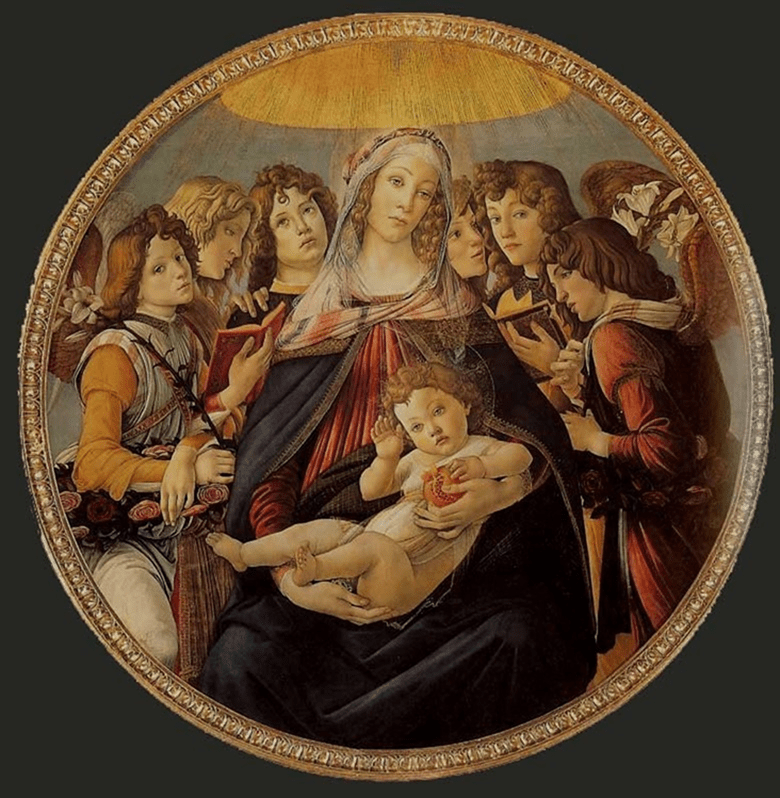
Madonna of the Pomegranate by Sandro Botticelli

 Daily Devotionals