Good Morning Friends,
Today on the eve of the Fourth of July, as many begin the celebration in advance, we consider all the hats we have worn in our past, currently wear now and might well wear in our future. And as we contemplate this, with some degree of honest introspection, and recognition that we need to be healed or our sins to really be free. And one question stares us in the face and challenges us to answer truthfully related to our own wounds and healing. Are Doubts Getting In The Way Of Us Having Our Primary Identity In Christ?
Scripture: So then you are no longer strangers and aliens, but you are citizens with the saints and also members of the household of God, built upon the foundation of the apostles and prophets, with Christ Jesus himself as the cornerstone. In him the whole structure is joined together and grows into a holy temple in the Lord; in whom you also are built together spiritually into a dwelling place for God.
Ephesians 2:19-22 (NRSV)
But Thomas (who was called the Twin), one of the twelve, was not with them when Jesus came. So the other disciples told him, “We have seen the Lord.” But he said to them, “Unless I see the mark of the nails in his hands, and put my finger in the mark of the nails and my hand in his side, I will not believe.” A week later his disciples were again in the house, and Thomas was with them. Although the doors were shut, Jesus came and stood among them and said, “Peace be with you.” Then he said to Thomas, “Put your finger here and see my hands. Reach out your hand and put it in my side. Do not doubt but believe.” Thomas answered him, “My Lord and my God!” Jesus said to him, “Have you believed because you have seen me? Blessed are those who have not seen and yet have come to believe.”
John 20:24-29 (NRSV)
Message: If we are not seeking to find our identity in Christ first, then we are seeking it in something else to our own detriment. For even though we believe our identity is in Christ we typically do not make it a priority and as a result fail to experience how this relationship is to change the way we live in practical ways. We typically discount this identity and get it all mixed up with being a spouse, parent, employee and member of one group or another. As the Apostle Paul came to the end of writing the second letter to the Ephesians, he explains that the Christians in the church in Ephesus had a new identity. They had transferred their allegiance from their former way of life, and they now had a new identity in Christ. Paul writes about their citizenship alluding to citizenship of God’s kingdom. Here the Kingdom of God is not a territorial jurisdiction, it is God himself ruling his people, and bestowing upon them all the privileges and responsibilities which divine rule implies. To this new international God-ruled community, Gentiles and Jews, slave and free, male and female, belonged on equal terms. Interestingly, Paul is writing while the Roman Empire has yet to show signs of its coming decline, let alone of its fall. Yet Paul sees this other kingdom of God as more splendid and enduring than Rome’s. And so, Paul rejoices in its citizenship more even than in his Roman citizenship. It is a kingdom made possible by the resurrected body of Christ. The walls and locked doors and boarders are no barrier to the resurrected Christ. Here Jesus ushers in this new kingdom proclaiming a relationship of peace but also displaying the marks of suffering on the Cross, all as witness that though the Lord has been crucified, he has most surely risen from the dead so we too might be changed. So, friends, this morning be confident that having one’s primary identity in Christ will produce things of eternal value. The
great purpose in our lives is to identify with and become more like Christ.
And So, we can be strangers in a strange land, or we can be more. You see, we are a people of hurt every one of us…. physical pain, emotional pain, addictions, cancers, insecurities and angers plague all those in the pews and those who have never seen one. Sadly, it is how we identify who we are. The question though is whether or not we want to own our hurt forever. And we probably will if we do not overcome our doubt enough to believe in a love greater than ourselves. Yes, part of the question is whether we want to get well. Perhaps you are working for God. Then again perhaps you are working for man. You really have to choose what you are going to do. One really has to think this through…. our actions…our motives. Take Thomas…. doubting Thomas. Why was he so concerned with the wounds? Oh, I understand his doubting. Without doubting there is no faith. What I do not get is Thomas’ logic. This is one confused man…incredulous and in denial. Did he really believe there was not a gaping hole in this man’s side? Really, why where the holes in the hands and side a satisfaction for the burden of proof for the real issue at hand? Thomas was not at the crucifixion and was not at the first Easter. Ok I get that. But if Thomas wanted some proof this was Jesus…a risen Christ…why does he contemplate poking a finger in Jesus to solve the issue? Why did Thomas not ask Jesus a personal question like: “Jesus, what did you say to me last week when you washed my feet?” If I was really doubting, I would have asked something like that, but it seems that the wounds were more of interest to Thomas than a means of identification. What is going on here? Friends, the only thing that makes sense to me is that Thomas was identifying his own wounds with Christ’s wounds more than worldly logic would lay claim to. Maybe we too will know each other by our wounds. Maybe Thomas needed the healing of his wounds. Maybe in a strange way Thomas was asking Christ to poke into his wounds too and to heal him. Maybe that was what Thomas was really looking for all along…. healing. Here healing happens when we too realize we might be healed by Jesus’ wounds. Here healing happens when we realize we too might be an agent of healing and demonstrate we have faith enough to place our identity in Christ. For further meditation on this I have included a copy of Caravaggio’s Doubting Thomas for your consideration. Note that Jesus looks much younger than the disciples in the painting.
Pray we face the truth of ourselves and the wounds we cling to. Pray we do not so identify with our wounds that we reject getting healed. Pray we have a personal encounter with the Risen Christ. Pray we turn and see God’s Kingdom. Pray we experience the joy, love and peace of the Risen Christ. Pray we realize that rest, Sabbath rest is the prophetic presence of Christ that both is forgiving and healing. Pray for those God has gifted to help heal. Pray for those empowered to tell others about Jesus.
Pray we delight in the peace offered by a resurrected Jesus. Pray we no longer chase after the desires of the world but instead seek to bring God glory in all areas of our life. Pray we become instruments of God’s righteousness. Pray we do not love the things of our body more than the Body of Christ as we rejoice in the indwelling of the Holy Spirit. Pray we have a legacy that is built to last because it is not built on pride. Pray we have an identity as citizens of God’s Kingdom in a place we can call home. Pray we have an identity as members of God’s family, sharing the same Father. Pray we understand that we are living stones of God’s Temple to abide in a place of eternity. Pray we realize that God is the architect of our existence forming us to fit into God’s plan of redemption. Pray we be at peace despite our skepticism because Christ is our Cornerstone. Pray we be without fear of the future because the Father of Creation is our foundation. Pray we realize that we have no need to judge or compare ourselves to other stones in the Temple but to serve Christ, in whom our identity is hidden as part of a greater whole now being healed.
Blessings,
John Lawson
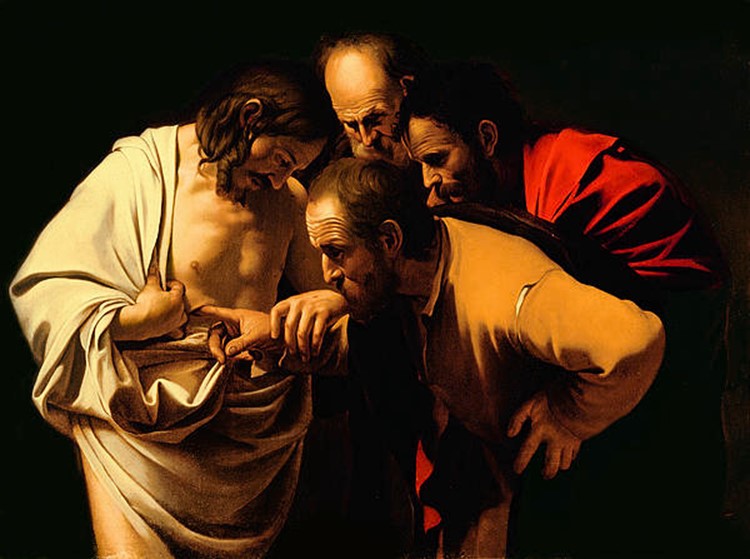
Caravaggio’s Doubting Thomas

 Daily Devotionals