Good Morning Friends,
Today’s lectionary passage is about remembering the blessing of life found in the Word becoming flesh and related to that the graphic sacrifice of the Passover Lamb for our life in Jesus. Life is in the blood friends, but it is also in a broken body given in service. And the description of it is often disturbing. It was for those in today’s storyline. To give us a picture of this reality we have two paintings of Caravaggio of the Supper at Emmaus. One follows the Luke Gospel narrative and the other Mark, both about the post crucifixion Jesus. They were painted five years apart but what is interesting about them both is that Jesus is painted without a beard and they have different levels of brightness. After all the disciples did not immediately recognize him. Realistically one would look different after being crucified. As you contemplate the paintings and the text about the meal realize that not everyone’s theology on today’s text about the bread and blood of life is the same. And I am not intent on creating more controversy however I have added a third painting of Caravaggio of a beheading to better tell the Caravaggio story. Somehow on some phycological level or perhaps spiritual, I think they combine in the hope of unity of a Body of Believers that supersedes those differences that cause theological controversy and separates us from a relationship with God. So, today, with that in mind, we meditate on a mystery that is not so much about death or losing our head, or of the negative examples of life or who we consider heroes, but of life and how we might live it for God despite being hopeless sinners. Hopefully there is something transformative going on beyond feeding the hungry and curing social ills and physical disease and life’s dramas here. So, Are You Recognizing Jesus In The Living Sacrifice Of Believers Today?
Scripture: Remember the long way that the Lord your God has led you these forty years in the wilderness, in order to humble you, testing you to know what was in your heart, whether or not you would keep his commandments. He humbled you by letting you hunger, then by feeding you with manna, with which neither you nor your ancestors were acquainted, in order to make you understand that one does not live by bread alone, but by every word that comes from the mouth of the Lord. then do not exalt yourself, forgetting the Lord your God, who brought you out of the land of Egypt, out of the house of slavery, who led you through the great and terrible wilderness, an arid wasteland with poisonous snakes and scorpions. He made water flow for you from flint rock, and fed you in the wilderness with manna that your ancestors did not know, to humble you and to test you, and in the end to do you good.
Deuteronomy 8:2-3, 14b-16a(NRSV)
The cup of blessing that we bless, is it not a sharing in the blood of Christ? The bread that we break, is it not a sharing in the body of Christ? Because there is one bread, we who are many are one body, for we all partake of the one bread.
1 Corinthians 10:16-17 (NRSV)
After this Jesus went to the other side of the Sea of Galilee, also called the Sea of Tiberias. A large crowd kept following him, because they saw the signs that he was doing for the sick. Jesus went up the mountain and sat down there with his disciples. Now the Passover, the festival of the Jews, was near. When he looked up and saw a large crowd coming toward him, Jesus said to Philip, “Where are we to buy bread for these people to eat?” He said this to test him, for he himself knew what he was going to do. Philip answered him, “Six months’ wages would not buy enough bread for each of them to get a little.” One of his disciples, Andrew, Simon Peter’s brother, said to him, “There is a boy here who has five barley loaves and two fish. But what are they among so many people?” Jesus said, “Make the people sit down.” Now there was a great deal of grass in the place; so they sat down, about five thousand in all. Then Jesus took the loaves, and when he had given thanks, he distributed them to those who were seated; so also the fish, as much as they wanted. When they were satisfied, he told his disciples, “Gather up the fragments left over, so that nothing may be lost.” So they gathered them up, and from the fragments of the five barley loaves, left by those who had eaten, they filled twelve baskets. When the people saw the sign that he had done, they began to say, “This is indeed the prophet who is to come into the world.” When Jesus realized that they were about to come and take him by force to make him king, he withdrew again to the mountain by himself. When evening came, his disciples went down to the sea, got into a boat, and started across the sea to Capernaum. It was now dark, and Jesus had not yet come to them. The sea became rough because a strong wind was blowing. When they had rowed about three or four miles, they saw Jesus walking on the sea and coming near the boat, and they were terrified. But he said to them, “It is I; do not be afraid.” Then they wanted to take him into the boat, and immediately the boat reached the land toward which they were going.
John 6:1-21 (NRSV)
I am the living bread that came down from heaven. Whoever eats of this bread will live forever; and the bread that I will give for the life of the world is my flesh.” The Jews then disputed among themselves, saying, “How can this man give us his flesh to eat?” So Jesus said to them, “Very truly, I tell you, unless you eat the flesh of the Son of Man and drink his blood, you have no life in you. Those who eat my flesh and drink my blood have eternal life, and I will raise them up on the last day; for my flesh is true food and my blood is true drink. Those who eat my flesh and drink my blood abide in me, and I in them. Just as the living Father sent me, and I live because of the Father, so whoever eats me will live because of me. This is the bread that came down from heaven, not like that which your ancestors ate, and they died. But the one who eats this bread will live forever.”
John 6:51-58 (NRSV)
When he was at the table with them, he took bread, blessed and broke it, and gave it to them. Then their eyes were opened, and they recognized him; and he vanished from their sight.
Luke 24: 30–31 (NRSV)
After this he appeared in another form to two of them, as they were walking into the country. And they went back and told the rest, but they did not believe them. Later he appeared to the eleven themselves as they were sitting at the table; and he upbraided them for their lack of faith and stubbornness, because they had not believed those who saw him after he had risen. And he said to them, “Go into all the world and proclaim the good news to the whole creation. The one who believes and is baptized will be saved; but the one who does not believe will be condemned. And these signs will accompany those who believe: by using my name they will cast out demons; they will speak in new tongues; they will pick up snakes in their hands, and if they drink any deadly thing, it will not hurt them; they will lay their hands on the sick, and they will recover.”
Mark 16: 12-18 (NRSV)
Message: Yes, the words from John are familiar but sometimes not always understood. The Feeding of the 5000 for example and its unification of the very small with the very large is just the beginning of a long unpacking of the bread of life theology that is way beyond and exponentially deeper and more significant than the concept of sharing our food. They are the same words made flesh and offered at the last supper and when we share them the memory of that event there is a certain intimacy if we mature in the relationship. But there is a difference in the context of John 6 and the events in the upper room at the Passover. Jesus’s words in today’s text were separated from the direct thought of the Paschal Lamb’s blood being spilled. Jesus had just fed the 5000 by multiply the loaves and fishes. Those who had experienced this miracle were now gathering around him, as the Israelites gathered around Moses, looking for physical sustenance not spiritual food. And Jesus tells them that such food as they are seeking is like manna and cannot last. Instead they need the whole being…the whole Word…the very flesh and blood of Christ in them. We are exploring here the incarnation of God who gets in the boat with us. For this story immediately follows the story of the feeding of the 5000, and what follows it is more commentary on the Bread of life. Interpretation of these words varies but the response to them when first uttered was that they were too graphic. The offer though on another level is a surprising description of the permanent participation of one life in another that is worthy of our meditation. For we must abide in God and God in us. Of course, Jews disputed among themselves the words then and they still are the focus of a lot of debate on who decides. But really, what is being said? When Jesus gets in the boat we arrive. When Jesus breaks the bread for the 5000 there is more than enough for all to have their fill and each of the disciples to have exactly a basket to take on the journey. It seems at one point that Jesus is giving the disciples and the followers a direct command like the one Moses gave to the Israelites to eat the manna; and so, in a likewise fashion, we hear in today’s scripture Jesus telling the Jewish crowd in front of him, to eat his body. Now in retrospect I believe we can say that Jesus is foreshadowing, not only the events of his death on the cross to come, but also of his atoning act of sacrifice for our sins through that event. But the crowds and even the disciples missed all this at the time. Even today the reality of Christ’s presence in the Word becoming flesh is beyond our comprehension. Still I think the message here is that we too are to join with Christ as a living sacrifice of our self-will so that we might be set free. That is one good reason to remember Christ every time we eat in this life in preparation for the next. It is a good reason to eat the Word and make God abiding in all things small and large our priority.
And So, we are to fight for the truth. We are to be drawn to service, but the resistance in us is real. We expect Jesus to look one way and he appears so different. Eternal life is still the goal, but we fight the greatest hope we can have based on our perception of what we see in the world and the immediate needs of people around us. Here is the conflict…the giving of our very flesh for the faith. But do not worry for God is in control. Jesus came not to be just useful in this regard but to be precious and change our desires profoundly so that our focus would be on God. So, it is not just about our physical and social needs as the body now but in eternity. Friends, on the other side there is life. So, we are to seek Jesus not for what he can do for us, but for the glory of who he is. The greater blessing is sealing us for eternity. Here we get to join Jesus and as we do realize that there will always be enough to accomplish what God has in mind. Indeed, God will supply what we need if we trust God and offer ourselves to God for the whole duration of our life. Sacrifice means we will not withhold any part of our life from God. For when we do, we get to see a bit of Jesus.
Pray we not just give bread but be bread. Pray we have a healthy appetite for what is truly nutritious. Pray we realize the solemn and sober truth about eternity. Pray we thank Jesus for teaching us how to have a life worth living. Pray we thank Jesus for the experience of communion and its shared personal fellowship with the divine. Pray we remember the sacrifice of Jesus on the cross and the symbolism of the bread and wine. Pray we eat, live and abide in the love of God. Pray we proclaim God’s work of creation, redemption and sanctification in us until his return. Pray Jesus multiply in us the bread of life. Pray we focus not on the product but the person of Christ who feeds us but more importantly transform us to love and serve and to be living sacrifices.
Blessings,
John Lawson
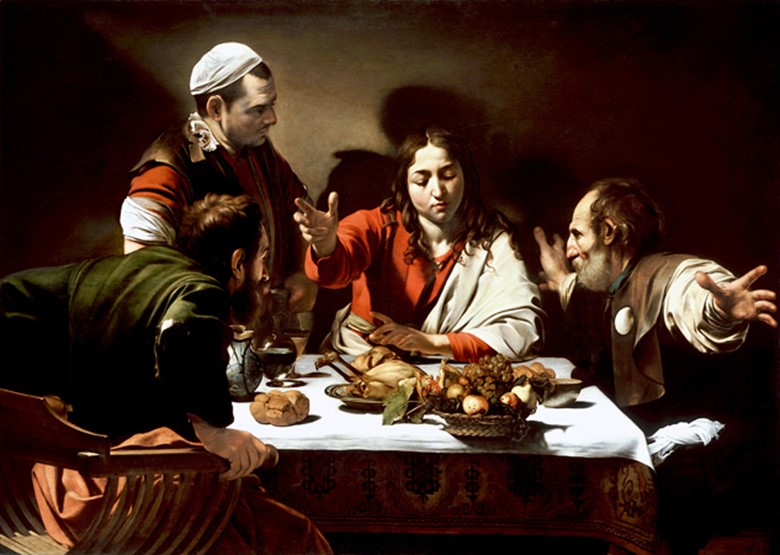
The Supper at Emmaus is a painting by Caravaggio, executed in 1601, and now in London, depicts the moment recounted in Luke when the resurrected but incognito Jesus reveals himself to two of his disciples in the town of Emmaus, only to soon vanish from their sight. The painting has a dark and blank background and gesturing that challenges our perspective. The painting uses the technique known as chiaroscuro where light emanates from an unknown source. The table lays out a still-life meal. Like the world these apostles knew, the basket of food teeters perilously over the edge. Much like Caravaggio’s own life.
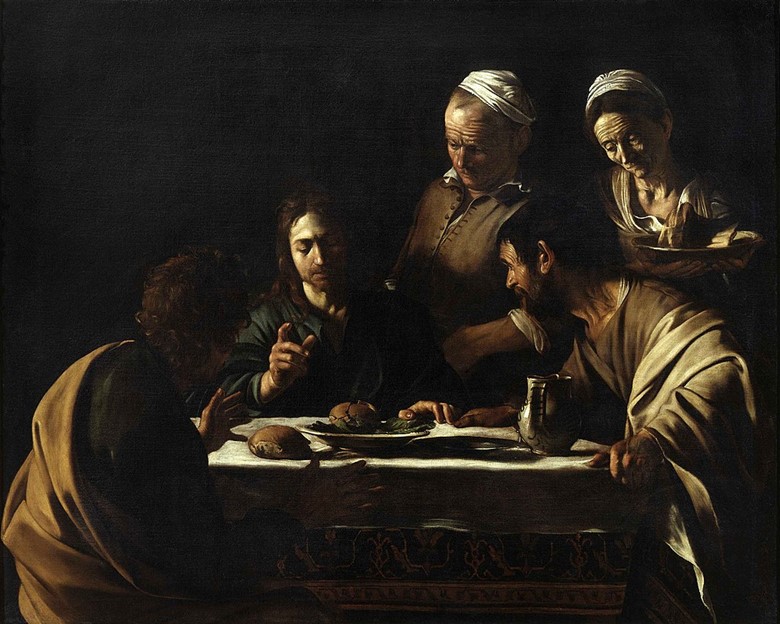
In the Gospel of Mark, Jesus is said to have appeared to them “in another form”, which may be why he is depicted beardless here in this 1606 version of the Supper at Emmaus by Caravaggio. By comparison with the one done five years earlier, the gestures of figures are far more restrained, making presence more important than performance. This difference possibly reflects the circumstances of Caravaggio’s life at that point. He had fled Rome, where he was considered their most famous painter as a nefarious outlaw following the death of Ranuccio Tomassoni, a pimp of one of Caravaggio’s favorite models. In the brawl Caravaggio seems to be trying to castrate Tomassoni and perhaps succeeding. Interestingly the dark background in this painting envelops the scene in a way that would help define a new painting technic of tenebrism in the ongoing evolution of his art. Interestingly it seems to recognize the value of understatement and that perhaps Jesus could enter our daily encounters such as a meal overshadowing the more graphic and sinful events in our lives.
Michelangelo Merisi da Caravaggio was born in a small town in northern Italy, near Milan from where he took his nickname, Caravaggio. He became an orphan at a young age with both his parents dying of the plague. Caravaggio had a violent temper which got him into fights both verbal and physical. Apparently in his 20’s he started his career as an artist, and it lasted only 13 to 15 years until his death on July 18, 1610. Only about 50 of Caravaggio’s paintings can be seen in their original condition. Despite his great talent his personal behavior was rather appalling. Caravaggio used prostitutes and people from the lower class of society as models for his paintings. This upset many who did not want to see prostitutes posing in the role of religious figures. Also, he placed himself in many paintings as well. Caravaggio even had a death warrant issued for him by the Pope following the murder of Tomassoni. The story goes that the brawl was over a woman named Fillide who was used as a model in the role of heroine in the following painting.
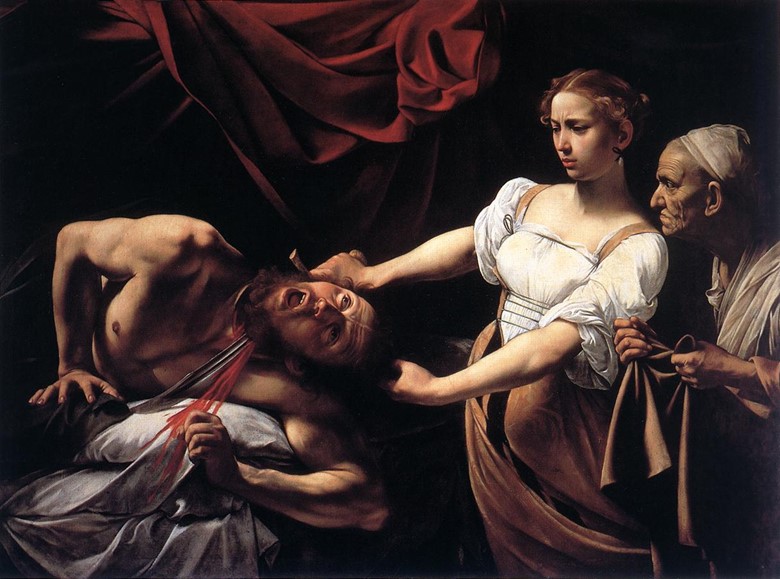
Judith Beheading Holofernes 1598-1599 by Caravaggio

 Daily Devotionals